Adult Play – Changing Styles
We have heard stories of bosses speaking to their employees saying: “There is work and there is play. Play is on your time and work is on mine. You’re on my time. Now, get back to work!”
What is play? If play is the opposite of work, then this is how this writer sees it occurring.
In this discussion of “play”, it is not what we see when we see young children at play. Much of what we call “play” in young children is really very serious attempts for each of the children to find their path individually to adulthood. This discussion of “play” is about our supervised “play” that is normally thought of as offering a release from the tensions of everyday living.
With the recent publication of “The Genetics of Personality Type” (Grygar, 2021 available Smashwords.com and Amazon Kindle), the way we look at elements making up the MBTI profile has changed. The E/I pair remained unscathed as a dominant/recessive gene pairing. The “S/N” was separated into two segments recognizing that everyone uses Sensing or Sensation but only 25% of population carry the “N” gene that is more about remembering than learning and that is a recessive part of a dominant-recessive pair. Everyone senses and that remains a constant integral part of personality type. “N”, however is different and is separately inherited by only 25% of the population. The hidden dominant part with “N”, which was labeled “X”, is most likely the gene that controls data processing during sleep when permanent memories are stored. The “T/F” pair was recognized as bringing in one’s sex into into the typing process. “T” is dominant for males and “F” is dominant for females and functioning of the two processes was seen as being more alike than different. Both “T” and “F” use logic to reach conclusions but the logic process is hidden from those using “F” while their process includes more non-linear information than is used by most “T” individuals. And, the last pair “P/J”:, are seen as being controlled by a gene switch, and were seen not as opposites but as coordinating pair. Before “J” can occur, the ‘P” function must supply enough information for a judgment to be rendered. When all the above is analyzed from a play standpoint, the “S/N” group becomes a constant and not something changeable during play. Basically, for play activities, everyone senses all of the time and only those with the “N” gene can effectively behave like someone with the “N” gene. Thus, “S” forms a separate group that does not cross over with “N” and visa versa.
We begin to play by recognizing an unscheduled play opportunity and allowing ourselves to move out of our normal work position. If we are normally an ESTJ – Amiable Driver, then we need to allow ourselves to move to the nearly opposite ISFP – Driving Expressive position. This normally happens one letter at time. The transformation could look something like this:
ESTJ to ISTJ to ISFJ to ISFP
The same changes would be occurring in our Social Style at the same time:
Amiable Driver to Analytical Driver to Analytical Amiable to Driving Expressive
The last stage where we actually assume the style near our opposite is not a stage that we allow out for all to see. It is a stage that we may let only our spouses, chosen family members, and very close friends see. We normally stop at some guarded step holding back on the last two transformations.
Of the four step chain seen above, the middle two transformations could involve any of the other nine types not at the beginning or the end of the chain as long as only one letter changes at a time. This would be true of all of the sixteen types transforming to its completely opposite type. There are actually many paths that could be taken to get from ESTJ to INFP. See below for all of the possible ESTJ to ISFP transformation patterns.
ESTJ to ISTJ to ISFJ to ISFP
ESTJ to ISTJ to ISTP to ISFP
ESTJ to ESFJ to ISFJ to ISFP
ESTJ to ESFJ to ESFP to ISFP
ESTJ to ESTP to ISTP to ISFP
ESTJ to ESTP to ESFP to ISFP
Every MBTI four letter pairing has its own set of six paths toward maximum play.

A quick review of the above chart indicates that Analyticals ultimately play in the Amiable Quadrant and and Amiables in the Analytical Quadrant and Drivers ultimately play in the Expressive Quadrant and the Expressives play in the Driver Quadrant. Each type has six different paths that will take them to the final destination. But within the six paths, different stages will include stages of all of the other quadrants not of the beginning or destination quadrants. If an “N” person is not exercising their “N” function at the time, work or play, they will appear to be using their “S” function. All paths for one type is shown below:
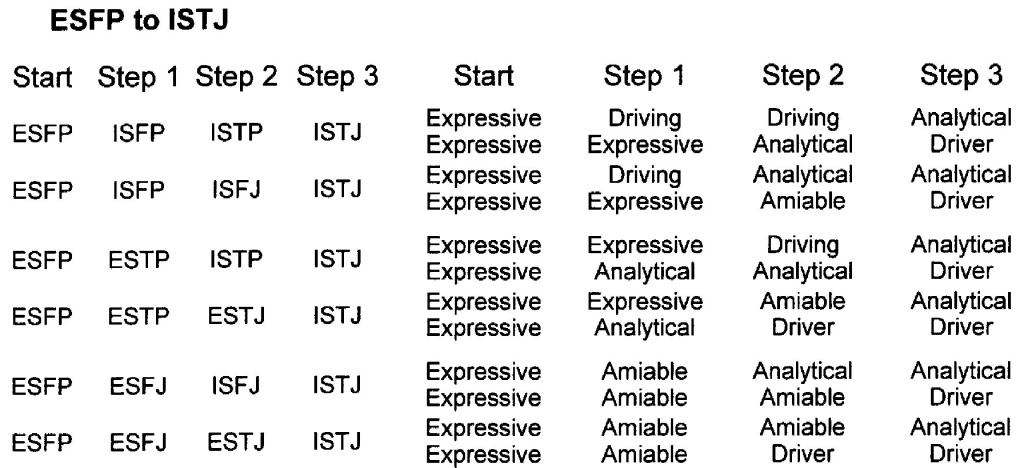
Will play normally involve style switching with the middle two Myers-Briggs type letters first? Or, can it involve either of the end letters first? The answer remains unknown. Will the solution to teaching people to play be found in the simpler Social Style model or will it need to be based upon the more complex Myers-Briggs types. This research has not been done yet. Because play transformation patterns can possibly include any of the six other styles in the same S or N sphere in going from the work to play pattern, it would be dangerous to try to use play transactions to try to determine the type of the person being observed.
Why do we hold back in switching from work to a full play mode? There are probably several answers that would include a nearly absolute distrust of those whom we have met with work styles completely opposite of our own. If we cannot work with “them” as our opposites, then how can we act “that” way in front of others? It is only by recognizing that style switches have to occur for us to play that some of us can begin to play. “I”s need to arrange to be with people for purposes other than work for full play opportunities to arise and “E”s may need to be alone or in a small group (less than four?) for them to experience their full play potential.
Does play necessarily involve humor or amusement? The simple answer is “no”. Yet, humor and amusement are actually separate categories(or parts of a single other category) that have the same effect as helping one relieve tension. The presence of either may make play more enjoyable.
Lover’s Exchanges
There is one time when the three switchable letters seem to switch and remain switched for short periods of time. When two people meet and each is seeking a mate, one or both persons may be switching to the opposite personality type while the information exchange is occurring. If the “getting to know you” phase is extremely short, and a marriage occurs too early, the morning after refrain may be “What have I got myself into?” Before committing to something that is supposed to be as long lasting as marriage or even living together, then you really need to know the other person well. This includes seeing them interacting with others both at work and at play including them with their and your friends and family and visa versa.
Behavior Not In Style
When someone is seen as behaving out of “Character” or social style, then there are several possibilities. These include:
1. A shift in our point of view of the current situation is taking place. This often can occur when the person is expecting or is under a verbal assault.
2. They are playing. The longer and more intense the play, the more likely that they could completely shift out of character from their basic social style. This type of change is what the above is about.
3. They are acting so as to be seen as other than their true selves for reasons known to them. There is a price for acting and it is the acceptance of additional tension within the actor.
4. They are exercising their communication skills in going out of character to try to communicate with others or a particular someone especially when persons of other psychological types are involved. Some of this type of action could probably be viewed as acting listed immediately above.
5. They may be involved in a lover’s exchange. Such exchanges occur infrequently.
6. They are under the influence of alcohol, drugs or both.
7. Some drugs and medications may result in social style changes either intentionally or as a side effect.
8. They may be entering into or are in a grieving process because of an event that happened to them or to someone close to them. They may be elating over some really good news.
9. The may be experiencing hormonal imbalances due to natural rhythms or severe stress (all).
10. Something is wrong with them physically of a very recent nature.
There is one additional area to be discussed and that is “Escapism” and the problems associated with its classification. Probably the most common form of this is picking up a book (older persons) or turning on electronic media (younger persons) and abandoning the world and events around us to engage in the world between the pages or on that seen and heard before us while ignoring that going on around us. And, in severe cases, it could even involve adopting a new personality (“Jekyll and Hyde” or “The three faces of Eve”) in its entirety. Excluding severe cases, is escapism “play”? It does not appear to be work. Does it need a warning label, “May become Addictive”?
Individual play paths are available Through your Psychological Type summary page. But expect to see some redundancy with what was said above.
****
 What is My Psychological Type