Recognizing Type in Others
The key to smooth daily repeat encounters with familiar others is recognizing the quadrant style of each key individual. Do not decide too quickly. Half of the people are decision makers who can easily make decisions. Of the decision makers, half are telling-controlled and the other half is asking-emoting or the two pairs being seeming opposites. They share one important quality-when either feels that they have enough information to make a good decision, they stop gathering more information. The other half or the non-easy decision makers are the “experience more or learn more groups” with half being asking-controlled and the other half being telling-emoting or seeming opposites again. The experience more or learn more group share the ability to easily make personal decisions concerning only themselves. Decisions made to be relied by others made by asking controlled group are often subject to change as more information is being developed. Decisions made by the telling-amiable group are often heavily influenced by the last person or group to talk to them before the decision is announced. When they (the experience more or learn more group) are not physically asking or telling, they are often letting their actions or accomplishments speak for them.
The telling-controlled group are decision makers, they logically present their decisions laying out the steps followed to reach their position or present their decision. They are controlled using limited displays of emotion and the often hide their internal emotions to all but a carefully chosen few. They are good at interrupting and finishing sentences started by others. They are loyal to institutions more so than to the individuals leading their trusted institutions. Confrontations are often a path to new learning and, if one can get their attention, they can be led to changing their position without holding a grudge or worse. Courteous smiles are seen often. Aware of the group/organization needs. Drivers.
The asking-animated group are decision makers who seek harmony and avoid confrontation within all of the groups that they are associated with as either leaders or co-workers. Some very intelligent persons in this group can logically explain many decisions that they make but, for them, the decision was made first and the explanation came later. They frequently will withhold voicing a decision if the decision would be unpopular with someone that they care about. They often are well-liked and aware of the needs of those around them and are loyal to individuals more than to their associated institutions. They are very open to showing their emotions and abhor logic in decisions involving people. When they are in leadership roles, most challenges to their decisions will be taken personally even when the “challenge” is really only a question of clarification of a situation not discussed. Amiables.
The asking-controlled group also known as an “experience more or learn more” group, prefer working with numbers or ideas while hiding their inner feelings and, often, their essential opinions. They ask for concrete, verifiable facts while avoiding speculation by either others or by themselves. Depending upon the problem or situation, they almost always prefer to be working alone but can work with others. Analyticals
The telling-animated group, also known as an “experience more or learn more” group, prefer working with persons and things while sharing their feelings and opinions with everyone. When in need of information, they will often reveal everything that know and what they do not but want or need to know. Depending upon the problem or situation, they almost always prefer to be working with a team or with many others. When in leadership roles, they demand loyalty to themselves and not necessarily to the institution that they represent. Aware of people’s needs. Impulsive. Expressives.
To try to identify someone’s type while they are playing is a fool’s task. The animation clues are frequent changing facial expressions, head turning/nodding, hand and arm movement, and frequent volume changes while speaking. 75% of all females are animated and 75% of males are controlled. Physically, control is indicated by a lack of animation. Asking is frequently indicated by being quieter and lacking aggression or pushiness. Telling is frequently indicated by strong eye contact, a bit louder modulated voice, and vocabulary that is demanding. Use the information in the above four paragraphs to arrive at quadrant behavior. Ask questions that will lead others to reveal themselves to you.
Recognizing Types – Part 2
There is one more Phase 3 part involving recognizing the other two elements but I ask that you delay at least two weeks before looking at it. There is no short and quick answers for analyzing the whole type and, for most people, you do not need this information. It would be better if you get to know the four quadrants well and from learning to use and using “Recognizing Type in Others” part 1 above then being weighed down with too much information before proceeding. During this time, you should also be learning the Interacting with Others plan presented to you and actually self testing to see if progress is seen in your relationships with others. Others may note a change in your behavior and, if they do, be honest with them and say that you are trying something new (without too much more explanation). If they persist, then telling them of this website would be okay. They probably wont go any further.
The other two letters are “E” (Exterior world orientation favoring people or things) or “I” (Interior world orientation favoring thoughts and ideas) and “S” (Sensing) and “N” (Intuition). The latter pair should probably read “S” (Sensing without intuition) or “N” (Sensing with Intuition). Again, do not decide too fast. Numerically, 75% of the population will be “E” and 25%, “I” and 25% of the population will be “N” (or sensing plus “N”) and the other 75% will be Sensing without intuition. Taken together, some 56% of the population will have “ES” as their first two MBTI letters.
Persons with an “E” or exterior world orientation prefer to work in groups and will avoid working alone. It is not necessary that those around them be working on the same project, just that they be present. They are sociable with many relationships especially away from work. They are mostly seen as being emoting though some may conceal chosen information about themselves. They enjoy conversations and especially like to talk about people (and very frequently about themselves) and about things people use. However, be aware that almost everyone needs to function in the world of people and things and some (whose interior preference is for the world of ideas and thoughts) are very good at accepting the level of tension necessary for them to appear to more sociable than they really would prefer to be. It is easy to misread such interior oriented individuals especially when they are in leadership roles.
Persons with an “I” or interior world orientation will often do their best work either alone or, if others are present, they will have tuned them out. Their preferred world is their inner world of concepts and ideas. They do not necessarily dislike people but the presence of others around will increase their stress levels and tire them out if they cannot tune out these others. However, be aware that almost everyone needs to function in the world of people and things and some whose interior preference is for the world of ideas and thoughts are very good at accepting the level of tension necessary for them to appear to more sociable than they really would prefer to be.
If we think of “E” and “I” as a description of a working pair orientation, then we can begin to see some profound differences between the two orientations. When a group of “E” oriented persons are working together on a physical project, they are concentrating on getting it done in the manner which they learned to follow. However, if there is “I” person working with them, that person’s mind in frequently wandering from the work at hand with their mind questioning everything that is going on around them. Does the project really need to be done? Are we doing it the right way? Could better tools be made to make the work easier or safer? They want a mental payoff from doing the work beyond the satisfaction that the job is being done right or that they are doing it with friends. In reading this, you will know where you fit in with what you are doing. If the “I” person can turn the actual work into play, then, they will be content with the “work” that they are doing. Large groups of individuals create problems for “I” individuals with much stress encountered. Their main tool for avoiding such stress is to create a cluster of individuals around them that they know who can, in effect, isolate them from the larger thongs of people.
The second MBTI letter, an “S” or an “N” is more difficult to discern. Everyone learns through their senses. What we are trying to identify is those who have genes that result in their receiving occasional hints or clues about connecting that which they are in the process of learning with something else that they already know. Such individuals seem to have a need to interrupt a speaker to ask a question, seek confirmation or make a comparison on a point made by the person being interrupted. They also have a tendency to complete sentences for other people whether or not they vocalize the completion for the speaker Approximately 25% of the population have this ability consciously to see or seek relationship information in real time and the other 75% will have the task performed unconsciously while they are asleep.
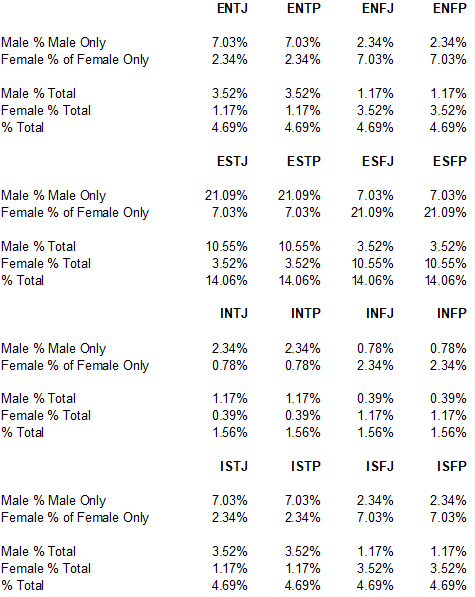
If you have been having a hard time finding someone like yourself, then the above table may help you see why you may have a problem. The rarest types for males are INFJ and INFP at 0.78% (slightly over ¾ of 1%) and for females, INTJ and INTP in like percentages. There is no one rarest type for either sex. (These numbers come from a article titled “The Genetics of Psychological Type” by Norbert Grygar available on Smashwords.com or Amazon.com)
These discussions are not all inclusive concerning behavior because individual behavior is not derived from genes only. Many other factors contribute to behavior including education, cultural norms, and intelligence to name a few other influences. The real challenge is to use what you see. If it works, keep learning.
For a summary of the key points in recognizing Styles and Types, Press the button below:
For a look at behavior outside of style or type, press here.
 What is My Psychological Type